<iframe width="200" height="113" src="https://www.youtube.com/embed/1g1KG8f1LWo?feature=oembed&rel=0&autoplay=1" frameborder="0" allow="accelerometer; autoplay; clipboard-write; encrypted-media; gyroscope; picture-in-picture; web-share" referrerpolicy="strict-origin-when-cross-origin" allowfullscreen title="What to Do if You are Injured as a Passenger in a Car Crash | Car Accident Lawyer Kenneth Berger"></iframe>
I was a passenger in a car accident, who do I file a personal injury claim against?
After a wreck, you have the right to file a personal injury claim against whichever insurance company covers the at-fault driver. Although you may be hesitant to file a claim, especially if the driver was a friend or part of your family, remember: this is what insurance is for. People pay insurance premiums every month for situations just like yours, so that you don’t have to take on the financial burden of the accident for expenses like medical bills and lost wages.What Compensation Can I Seek as a Passenger?
South Carolina injury law is designed to place you in the position you enjoyed prior to the car accident, which means you can seek compensation for:- Medical bills
- Lost wages
- Lost enjoyment of life
- And all other “damages” such as physical pain or suffering
Are passengers covered by car insurance in Columbia, SC?
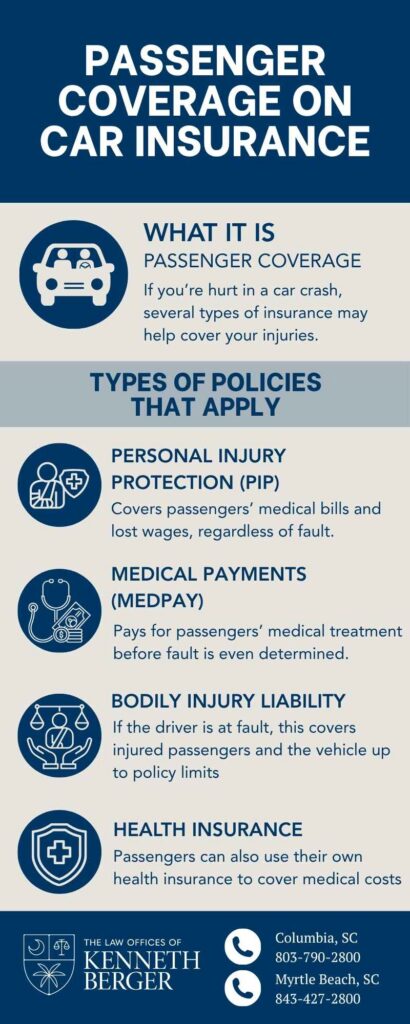 Yes, passengers are covered by a few different types of car insurance, including:
- Personal Injury Payment (PIP). PIP covers expenses like medical bills and lost wages after an accident. If your driver has a PIP policy included in his insurance coverage, you can file a claim with his PIP policy regardless of who was at fault.
- Medical Payment (MedPay). MedPay helps pay medical expenses after a wreck. Like PIP, MedPay is a “no-fault” type of coverage, so you can file a claim with the driver’s MedPay policy regardless of who caused the accident.
- Bodily Injury Coverage. Bodily injury coverage is what most people imagine when they think about car insurance after a wreck. In South Carolina, every driver is required to carry $25,000 in bodily injury coverage – though, of course, some people break this law, and other people have much more than this minimal amount.
- Health Insurance. You should always file all of your medical bills with your health insurance company. Even though you may have to reimburse the health insurance company out of your settlement, this will end up saving you a lot of money on medical expenses in the future because health insurance companies have negotiated lower treatment costs with the hospital. An attorney can also help negotiate down your medical liens so that you keep a greater percentage of your settlement or verdict.
The at-fault driver did not have insurance, what can I do?
Even if the at-fault driver did not have insurance, passengers still have multiple recovery options after a wreck. We break it down in the flowchart below.
If the driver of the car you were in was at-fault and does not have insurance or does not have enough insurance to cover all your damages, you may be able to rely on your own uninsured (UM) or underinsured (UIM) motorist policy. You can also use your own Personal Injury Protection (PIP) or Medical Payments (MedPay) coverage if you have it.
If the at-fault driver was in the other car, and he doesn’t have insurance or not have enough insurance to cover all your damages, you can rely on your driver’s PIP, MedPay, Uninsured or Underinsured motorist coverage. In addition, you can utilize your own auto insurance coverages to protect yourself and your finances in these situations.