A third-party injury claim is a personal injury claim against the person or business whose negligence or wrongdoing caused your injury. Their liability insurance company may handle and pay the claim. For example, if a driver runs a red light and hits you, you may pursue a third-party claim against that driver, typically through the driver's liability insurer. Third-party claims are especially important after a work injury. In South Carolina, workers' compensation is generally your only remedy against your employer, and it doesn't pay for pain and suffering. But if someone other than your employer, like a negligent driver or the manufacturer of defective equipment, caused your injury, you may be able to bring a third-party claim in addition to your workers' comp claim.
Hurt at work, and think someone other than your employer may be responsible? Call our office for a free consultation at 803-790-2800 (Columbia) or 843-427-2800 (Myrtle Beach).
Table of Contents
- What Is a Third-Party Injury Claim?
- First-Party vs. Third-Party Claims
- Third-Party Claims After a Work Injury in South Carolina
- Other Common Third-Party Injury Claims in South Carolina
- How to File a Third-Party Injury Claim in South Carolina
- How Long Do You Have to File a Third-Party Claim in South Carolina?
- How Our South Carolina Injury Lawyers Help
- Frequently Asked Questions About South Carolina Third Party Injury Claims
What Is a Third-Party Injury Claim?
In an ordinary personal injury case, a third-party claim simply means you are seeking damages from the person or business legally responsible for your injury, rather than from your own insurance company. Their liability insurer often handles the claim, but the claim itself is against the responsible person or business.
After a work injury, the term has a more specific meaning. The responsible person or company is a "third party" because they're outside the workers' compensation relationship between you and your employer.
First-Party vs. Third-Party Claims
A first-party claim is a claim against your own insurance company. For example, if an uninsured driver hits you, you might file an uninsured motorist claim under your own auto policy.
A third-party claim is a claim against the insurance of the person or business that caused your injury. If a reckless driver T-bones your car, you may pursue a third-party claim against the at-fault driver, typically through the driver's liability insurer.
Many injury cases involve both. After a serious crash, you may have a third-party claim against the at-fault driver and a first-party claim under your own underinsured motorist coverage if their policy isn't enough.
Third-Party Claims After a Work Injury in South Carolina
This is where third-party claims matter most, and where they're most often overlooked.
When you're hurt on the job in South Carolina, you generally can't sue your employer. Under S.C. Code Section 42-1-540, workers' compensation is usually your only remedy against your employer, and claims are handled through the South Carolina Workers' Compensation Commission. Workers' comp pays for medical care, part of your lost wages, and permanent disability benefits. It doesn't pay for pain and suffering or loss of enjoyment of life.
A third-party claim is a separate personal injury claim against someone other than your employer who caused your injury. South Carolina law, in S.C. Code Section 42-1-560, specifically allows injured workers to pursue these claims, and you can often pursue both claims at the same time. They come up often in South Carolina's construction, manufacturing, and transportation industries, where workers share roads, job sites, and equipment with other companies.
| Workers' Comp Claim | Third-Party Claim | |
|---|---|---|
| Who pays | Your employer's workers' comp insurer | The responsible party's liability insurer |
| Do you have to prove fault? | Generally no | Yes |
| Medical expenses | Authorized medical treatment is paid | Past and future medical expenses may be recoverable |
| Lost wages | Generally two-thirds of your average weekly wage, up to a yearly maximum | Past and future lost income or earning capacity, if proven |
| Pain and suffering | No | Yes |
| Loss of enjoyment of life | No | Yes |
Who Can Be a Third Party in a Work Injury Case?
Depending on the facts, third parties may include:
- Other drivers. If you were hit by another vehicle while driving for work, making deliveries around Columbia, or working on a road crew along I-26 or US-17, the at-fault driver may be responsible. This is one of the most common third-party claims. Here's more on crashes while driving your personal vehicle for work.
- Equipment and product manufacturers, when defective machinery, tools, ladders, scaffolding, or safety gear causes an injury. Learn more about defective product claims.
- Property owners, in some situations, when you're injured on property your employer doesn't own or control
- Utility companies, in some cases involving power lines or electrical hazards. Learn more about electrical injury claims.
- Other companies on a job site that aren't part of your employer's chain of contracts
Third-party claims are especially common after construction accidents, where many companies, vehicles, and pieces of equipment share the same job site. Here's more on third parties who can be liable for workplace burn injuries.
Who Usually Can't Be Sued?
Your employer and, in most cases, your coworkers are generally protected from lawsuits for work injuries. South Carolina's "statutory employer" rules can also protect certain general contractors, subcontractors, and project owners, depending on how the project's contracts are structured and the work being done. That's why third-party claims on job sites require a careful look at the contracts and companies involved.
How Workers' Comp and a Third-Party Claim Work Together in South Carolina
If you recover money from a third party, your employer's workers' comp insurance company generally has a lien or reimbursement right against the third-party recovery for benefits it paid, usually reduced by a share of the attorney fees and costs of the third-party case. The two claims affect each other, so they should be handled together from the start. Settling one without considering the other can cost you money. Learn more about filing both a workers' comp and personal injury claim.
Other Common Third-Party Injury Claims in South Carolina
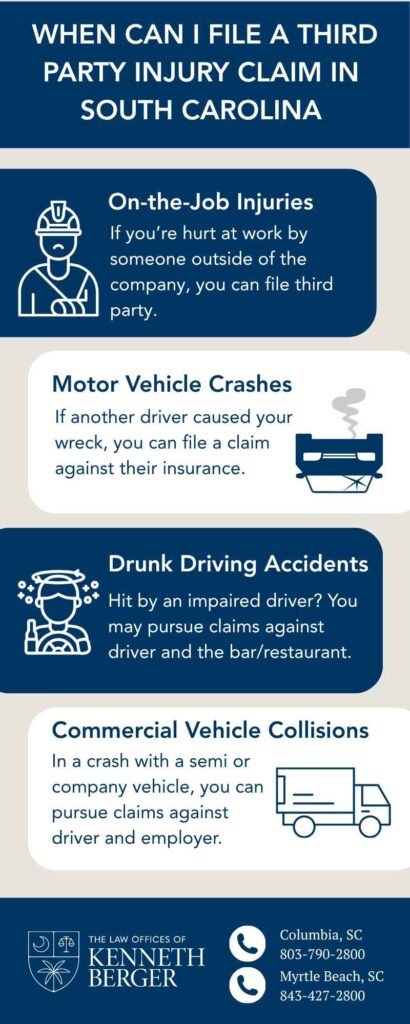
Car, truck, and motorcycle crashes. If another driver caused your crash, you can file a third-party claim against their auto insurance. In commercial truck crashes, responsible parties may include the driver, the trucking company, the company that maintained the truck, and the company that loaded the cargo.
Drunk driving crashes. In addition to a claim against the drunk driver, you may have a claim against a bar, restaurant, or other alcohol licensee if the requirements of South Carolina's current alcohol-liability law are met, including in some cases evidence that alcohol was knowingly served to a visibly intoxicated person.
Defective products. When a product malfunctions and causes an injury, the manufacturer, distributor, seller, or another company in the supply chain may be responsible.
Unsafe property. Property owners and businesses can be responsible for injuries caused by dangerous conditions they knew or should have known about. Learn more about premises liability claims.
Dog bites. In many cases, a dog owner's homeowner's or renter's insurance covers dog bite injuries.
How to File a Third-Party Injury Claim in South Carolina
A third-party claim often starts by identifying the responsible person or business and notifying their liability insurer, if one applies. To support your claim, you'll typically need:
- The responsible party's name and any insurance information
- A police, incident, or accident report, if one was made
- Photos of the scene, the vehicles or equipment, and your injuries
- Names and contact information for witnesses
- Your medical records and bills
- Proof of lost income, like pay stubs or a letter from your employer
- Records of your pain, limitations, and how the injury affects your daily life
Once the extent of your injuries and future needs can be reasonably evaluated, your lawyer may send a demand to the insurance company and begin settlement negotiations. If the insurance company won't make a fair offer, filing a lawsuit is often what moves the claim forward.
Be careful about giving a recorded statement to the other party's insurance company before talking with a lawyer. Here's more on dealing with insurance adjusters.
How Long Do You Have to File a Third-Party Claim in South Carolina?
In South Carolina, most personal injury claims must be filed within three years under S.C. Code Section 15-3-530. Claims involving government entities follow different notice and filing rules and can have shorter deadlines than ordinary personal injury claims. If you were hurt at work, you also generally must report the injury to your employer within 90 days and file a workers' comp claim within two years. Some situations have different deadlines, so it's best to talk with an attorney early.
How Our South Carolina Injury Lawyers Help
Third-party claims are easy to miss, especially after a work injury, when it seems like workers' comp is the only option. From the first conversation, we look at every possible source of recovery: workers' comp, third-party claims, and your own insurance coverage. We investigate how the injury happened, identify every responsible party, and handle the claims together so one doesn't undercut the other. We keep you informed at every step.
We represent injured people throughout South Carolina from our offices in Columbia and Myrtle Beach, serving the Midlands, the Grand Strand, and communities across the state.
If you were seriously injured and think someone else may be responsible, call our office for a free consultation at 803-790-2800 (Columbia) or 843-427-2800 (Myrtle Beach). You owe no attorney fees or case costs unless we recover money for you.
Frequently Asked Questions About South Carolina Third Party Injury Claims
It's a personal injury claim against the person or business that caused your injury, as opposed to a claim against your own insurance. Their liability insurer may handle or pay the claim. After a work injury, it means a claim against someone other than your employer.
Yes. If someone other than your employer caused your work injury, you can often pursue both. The two claims affect each other, so they should be handled together.
Not through workers' comp. But if a third party caused your injury, a third-party claim can include pain and suffering and loss of enjoyment of life.
Generally, the workers' comp insurer has a lien or reimbursement right against a third-party recovery for the benefits it paid, usually reduced by a share of the attorney fees and costs.
Generally, no. Workers' comp is usually your only remedy against your employer, and coworkers are generally protected as well. But you may have a claim against another responsible party.
The at-fault party's insurance information, any accident or incident report, photos, witness information, medical records and bills, and proof of lost income.